Sarah James

the possibilities of poetry…

In my latest interview for In the Booklight, I talk to Alistair Noon about his poetry collection Paradise Takeaway (Two Rivers Press)…

If you had to sum up what ‘Paradise Takeaway’ is about in just one sentence, what would you say?

I’ve been referring to it as a “long poem with Luton Airport in it”. Alternatively: it’s about returning to the UK periodically over thirty years or so, or at least takes off from that experience. I’d hope, of course, that it can be read as more than that, but that’s up to and down to the reader of course.

“It vanished behind us. I thought of the time
before we’d got shot of the ground
and I’d met the eyes of a cabin crew
whose souls were Heathrow-bound.”
(from V)

 
It’s a hard feat to pull off a book-length narrative poem. ‘Paradise Takeaway’ not only does this but is a gripping read. As a reader, I think the humour, the rhyming form and its having 23 numbered sections rather than being presented as an entirely unbroken flow are part of the appeal. But I’m wondering how writing in form worked for you from the writer’s perspective. Did it help you write, or did it make it more difficult, and in what ways? And what was the hardest part in the writing, and why?

I’m hardly the first person to say it, but using a relatively fixed pattern (whether one that’s been used a thousand times before, or one that’s novel) can of course generate ideas and images that wouldn’t otherwise occur. It’s certainly not the only way to generate those things, and much great poetry manages to do so without recourse to such patterns. But I do think such relatively fixed patterns, if you can pull them off, often add an extra level of depth, meaning and enjoyment that wouldn’t be there otherwise. So for me, this approach helps me write rather than makes it more difficult.

The hardest part was probably getting the thing in the right sequence. Two or three sections got ditched not because I thought they were necessarily bad but I just couldn’t get them into the sequence without digressing even more than the end product (hopefully enjoyably) does.

“At Luton Arrivals I looked about
at Pret-A-Put-On-Weight,
The Body Mass Shop and Burger Thing:
my mouth swam up to the bait.”
(from III)

I mentioned humour. It’s sometimes, perhaps, tongue-in-cheek, or surreal, other times quite sharp-edged. This particular section that I’ve quoted from expands into an imaginative observation on the narrator’s waistline, then onto the capitalist angle and actual labour involved in producing food and clothes. How naturally does this humorous slant come to you and did you tend to have to scale up your initial spark of humour or scale it down when you were writing ‘Paradise Takeaway’?

If only that observation of the narrator’s waistline was as imaginative as you say, in fact it was more a piece of realism :-). I stand in awe of real comedians (well, the good ones at least) and how they knock out gag after gag. I can’t do that and simply write as I feel and sense things, without consciously scaling any humour up or down. I did have a model for all this: Heinrich Heine’s Germany: A Winter’s Tale, which has Heine’s typical irony and humour. I’m not sure I borrowed those from him as such, but he does serve as a model and a kind of permission to write like this.

Photo by Clare Jephcott

“and on this rock where waves do stage-dives
from Caithness down to Kent,
the rich have never been far from the poor,
investment far from its rent,”
(from XI)

Politics and society, place and travel (as they are and how they’ve changed) run throughout this book. Obviously, they’re interlinked, and the political and societal closely so. But which of these is of the most interest and/or inspiration to you and why?

That’s a very interesting question. Perhaps surprisingly (at least for anyone who knows the kind of geographical poems that used to be my stock in trade), I don’t think I’m actually that interested in place and travel as phenomena in their own right, though there are certainly places that interest me, and you could see Paradise Takeaway as being about a particular kind of travel: someone returning to their country of origin after a certain time (in Heine’s case, on a single occasion after thirteen years of exile in Paris; in mine, on multiple occasions over thirty years in Berlin).

On the inspiration front, the book draws on what some might call high-brow learning, knowledge and culture (Brecht amongst others) and more popular culture and colloquial language. (The collection travels a lot in more than just terms of location!) Could you talk about the importance of mixing and juxtaposing these elements?

Thank you for noticing and mentioning that. I have two opposite if not quite equal antipathies in this regard. The first is to that so-called high-brow culture when it’s drawn on simply as a social marker of the speaker’s supposed cultural competence (which usually turns out to be pretty threadbare anyway). The second is the opposite, if more readily understandable tendency to reject that entire high-brow culture out of hand and go totally anti-intellectual. There are people in my family who grew up in a very working-class environment who could and can nevertheless hold their own in any debate because they simply read everything they could lay their hands on. That said, one of those people has already given me a bit of grief because of what she sees as the book’s overly juicy language.

Related to my previous question, Marmite appears not only in the book’s promotional blurb from your publisher but also recurs in the poem itself, as does the Paradise Takeaway of the title. What led you to choose these as motifs? With this question, I’m thinking in terms of their potential symbolic relevance as much as their literal functions within the narrative.

Paradise Takeaway is a fast food joint on the Dunstable Road along which the interminable bus from Luton Airport to Aylesbury goes. I’ve never eaten there, but in the days when Luton was my usual port of entry into the UK, I passed it many times and the name just seemed evocative. It’s also a kind of echo of my first collection, Earth Records (named after an indy record shop in Aylesbury when I was a lad), even if the books don’t really have much to do with each other directly.

The Marmite is such a central motif in the book that I’m reluctant to spell out what I think it might be saying, as I really don’t want to get in the way of the reading process. But clearly, there’s something local, visceral, tribal, perhaps nostalgic about it. I have a feeling that readers are going to have a better understanding of this than me.

[Note from Sarah: Just to give readers a flavour of this, the narrator’s “favourite yeast extract” is also “that black agate”, “the glassy prize”, “a national jewel” and more in VIII alone.]

Following on from this, and because food/consuming food (alongside other forms of consuming/buying) is another recurring focus within the book. What is your favourite food – speaking for yourself and in terms of the poet-narrator? And, again, why?

The poet-narrator in the book will eat just about anything vegetarian (though he ends up with a craving for fish and chips). The real-life poet isn’t too dissimilar, but hates parsnips and loves Sichuan Hotpot – which is kind of the Chinese equivalent of going for a curry.

Earlier, I mentioned the book’s wonderful use of colloquial language, which includes reflecting accents and characteristics, such as the sounding of ‘r’s as ‘w’s in “wecalling the seventies scwipts” (from X). I’m also in love with the verb ‘trib’ (as it features in the book, rather than the Wiktionary slang use that I only discovered later when googling). Could you talk about language in poetry and what ‘making it new’ means to you as a poet? And also, as an example of this, the dictionary definition you’d give for ‘to trib’ in terms of how it’s used in ‘Paradise Takeaway’?

“Trib” as a noun is one of two anagrams in that bit of the poem, the other one being “N’zisA”. In the poem, the verb is what the Tribs (or Tribbians) do. Er, I’ve just checked that slang meaning in Wikipedia, which is the first time I’ve ever seen it, and no, that’s not what I was thinking of :-).

Despite his abysmal politics, Ezra Pound’s injunction to “make it new” does encapsulate something important, even if you could disquire at length on each of the three words in the slogan. I will fess up to saying that this book is probably the most overtly personal one I’ve written to date. But I’d be wary of recommending that as a one-size-fits-all way to write: there are poets whose work I see worth in but where I find myself willing them to write less personally. Personal all on its own can, paradoxically, end up being very generic unless there’s some other process going on too, I think.

Where can people get hold of a copy of ‘Paradise Takeaway’?

Good question. For UK purchasers, all the usual outlets will work though it’s always, of course, worth supporting the press directly (Two Rivers) or local bookshops by ordering it from them. Blackwell’s online shop would seem to be a good bet for people in the EU. No idea yet of the best way of effecting cross-Atlantic sales, given the current exorbitant postal charges.

 
Thank you, Alistair, for these wonderful insights into ‘Paradise Takeaway’, your inspiration, writing process and some of the background to this book.

To read more In the Booklight interviews with authors, please click on this link.

In my latest interview for In the Booklight, I talk to David Clarke about his poetry collection The Field in Winter (Nine Arches Press)…

‘The Field in Winter’ has, justifiably, already received a lot of praise for its crafting. I’m quoting out of context here, but it seems to me that we have, on the one hand, “the [or a] poem’s uneven threshold” (‘Reciting a poem by Czesław Miłosz at Krasnogruda’) and, on the other, “They’ve learned the charm of words / we use to keep our dear ones close / when we’ve been careless with their hearts.” (‘“Sweetie”’). Metaphorically in terms of the collection as a whole rather than just these specific poems, I want to equate uneven thresholds maybe with subject matter, and perhaps more specifically with emotions and the realities of life, which we might then try to pin down, tidy or sum up in words. Could you talk about these kinds of different tensions at play in your work and how poetry does, and doesn’t, manage to encapsulate real-life truths and emotions?

That’s a difficult question to answer in a straightforward way. In the end, words are all a poet has to work with, and they are always inadequate, of course, never quite capturing the moment, never quite expressing what we really wanted to say. Perhaps ‘inadequate’ is not the word: it’s more that words have a power of their own that can’t quite be subjected to our will. I’m sure that’s a common experience everyone can relate to in their own lives. We are so often misunderstood!

On the other hand, though, the promise of poems is that they reach out towards something essential, which we couldn’t describe in another way. They have a paradoxical relationship to truth, in that they can make us feel as if we’ve been in its presence, without our being able to translate that truth back into everyday language. From that point of view, they don’t serve a practical purpose – they don’t help us to find anything out – but if art isn’t there to reveal something to us, however fleetingly, then I’m not sure what it is for.

I like the idea of poems having uneven thresholds, or of their being somehow resistant. I don’t mean this in the sense of being difficult or obscure, but a poem can be too easy to read; its emotional message can be too digestible and unambiguous. If I can read a book of poems quickly, I think there is something wrong; but if I have to put the book down after each poem, intellectually and emotionally limbering up for the next one, then I know it’s good work.

“The forest moves with industries

that silence us, reduce our progress
to scuff of boots on gravel
as we carry the moon on our backs.”
(‘The Path from Krasnogruda to Ogrodniki’)

This is another poem where I feel the distance between words and experience is highlighted, and one of the effects of this potentially being a distancing too from the world (that words are trying to describe). Reading this metaphorically as well as literally, unlike Atlas, the narrator here has the weight of the moon on their back, rather than the weight of the world, and I wonder if you could say more about what you’re exploring here, both in terms of this particular poem and how similar concerns and experiences may also be found in other poems in the collection?

This poem came out of a very particular experience of attending a seminar led by eminent scholars, who were concerned with philosophy and political theory. As it happened, the seminar took place in a very remote location, and walking home each evening from these intellectual discussions brought home to me that distance between our human sense-making and what we call ‘Nature’. Now we understand more fully that nature is not a sphere apart from the human world: in the Anthropocene, we have come to see that human activity has shaped the context in which other species have their existence, and that our lives are inextricably bound up with an environment that will not submit to our supposed mastery. We may have a significant impact on the world in which nature unfolds, but it is always strange to us, is always more than our attempts to describe and shape it.

I’m interested that you have picked up on that image of carrying the moon. I’d not seen the connection to Atlas, but it makes sense to me, and may even have been part of the reason I chose that image, however unconsciously. It makes sense to me as an interpretation, because the human talk and argument that opens the poem (so, the discursive and rational) is contrasted with the moon as a symbol of the otherness of the non-human world. If human intellect cannot at least take account of that otherness, its value seems questionable.

The natural world and animals, or animals in comparison to, or relationship with, humans, feature a lot in the poems – a stork, flies, spider, mouse, rabbit, a ‘twilight made of birds’, cows, an urban fox, a toad… Is there one animal that you find particularly inspirational, and why? Also, in terms of the interaction between animals and humans, especially in these poems, is the relationship between the two a coincidental one of different species just happening to be in the same place at the same moment (captured in the poem) or is it something more than that?

Someone once told me I was an ‘urban poet’. I think they meant it to be disparaging, but they were using what I would consider to be a fairly simplistic division between the urban and the rural. I don’t live in the countryside, but a lot of the animals in these poems (a sparrowhawk, a toad, foxes, the flies, a spider, doves) are part of my everyday experience – they can be seen regularly on the street where I live, in our garden, or even in our house. From that point of view, these encounters are simply coincidental, since they really did happen to me in the place where I live (or occasionally in places I was visiting or passing through). More importantly, however, these poems (and many others in the book) are about transformation: they focus on moments when the shape of the self changes in response to otherness. Since you mention my Miłosz poem in your first question, I’m reminded here of his poem ‘Ars poetica?’, where he says

The purpose of poetry is to remind us
how difficult it is to remain just one person,
for our house is open, there are no keys in the doors

With these animals encounters, I am exploring ways in which my own ‘house’, both literally and metaphorically, is open.

Specific places feature in a lot of the poems, as most immediately seen in their titles – Krasnogruda, Royal Well, Fen Lane, Exmoor… Is a sense of place something you find particularly inspirational? And is the primary importance the place itself, or is it what happens or is seen there, with the location itself just another (albeit potentially anchoring) detail within that experience?

A lot of these poems started with different titles, but I began to feel like I was closing down the meaning of the poems by trying to impose titles that would have shaped their reception. As with the animal poems, which quite often just say what kind of animal the poem is about in the title, the poems with place names tell the reader ‘what I’m telling you about happened here.’ I realise that a lot of my readers will not know the places concerned: they are linked to my own personal history and not necessarily significant to anyone else. Nevertheless, I hope that just using a place name, saying where these experiences really did happen, will leave the significance of the poem open.

“In certain weather, we see the space
between all things.”
(‘A Spider’s Web on Exmoor’)

This question may be circling back to others that I’ve already asked with regards to craft and the capacity of words to capture experience (or not). Space is an important part of any poem, and I think particularly so in this collection, where it gives the images room to breathe and the reader room for their full import to sink in. For me, it also feels like a lot of care and precision has been taken in the words chosen, and that in some ways, the more exact these words/lines are, the more possibilities – for thought, inference, expansion – open up in the space around them. How does space work for you in a poem and how easy or difficult do you find it to reach this level of precision and balance of words and space?

This book is what you might call a ‘slim volume’, and the poems themselves are not always very long. But I can honestly say that I have never worked so hard on paring poems down so that they only contained what absolutely needed to be there. The challenge to myself was to say as much as I could with as few words as possible, but also to move towards a greater emotional directness. I’ve felt very uncertain about this, and I still do struggle with that feeling, as I’d developed a style in earlier work that relished verbal excess and invention, and which often favoured a more ironic tone. Letting go of that established approach feels very exposing, even in the very pragmatic sense of experiencing the contrary impulse to give the reader more ‘value for money’ (More poems! Longer poems!).

Earlier in this interview, I said that words are all a poet has to work with. As Glyn Maxwell writes, though, we really have two materials: words and the white space around the words. As you rightly point out, fewer words means more space, which exposes the few words that are left, places more of a burden on them. I honestly don’t know if the balance is right, but I’m hoping the reader will take the time necessary to read (and re-read) the words and the space around them.

“ And if we have love it is this – to know the struggle

of another body, with our hands
to soothe each transformation.”
(‘Liniment’)

This poem is one of a number of extremely beautiful and moving father-son poems in the collection. But I also feel that, in a way, each poem in the book is itself an act both of love and transformation, for the world and life, if not a specific individual. Could you say more about the general relationship between love and transformation, particularly in regards to the role(s) they play in poetry and in ‘The Field in Winter’ especially?

I’m glad you’ve highlighted the word ‘transformation’ there, as I have in my answer to one of your previous questions. Of course, I only know what it is like to be human (or my version of it), but the main thing I know about being a human is that living is transformation. We are never just one thing, we are always in process. I think that is something we tried hard to repress, as fixated we as we are on the idea of the self and identity. Our society’s attitude to ageing is particularly worrying in this respect: that mantra of ‘age is just a number’ seems to me to deny the ever-changing nature of our physical being and its effects on our experience of the world. My father’s illness and death, which took place during the writing of the collection, and the moment of entering my own sixth decade certainly sharpened my mind to these questions. There’s no denying that change can be terribly sad, as when the people we love enter their physical decline, but I do believe that bearing witness to that can be an act of love.

‘The Field in Winter’ is your third full collection and you’ve also published several pamphlets. (I did an In the Booklight interview with you for your first collection ‘Arc’ (Nine Arches Press, 2015), which can be found here, and I was delighted in my editor role to publish your pamphlet ‘Scare Stories’ (V. Press, 2017).) Would you describe ‘The Field in Winter’ as continuing/expanding on your earlier work, or is it more taking it in a new direction, or perhaps a mixture of both, and in what ways does it do this?

I’m so grateful for the support you’ve given my work, Sarah! It’s good to have an opportunity to say that publicly. To me, the new book feels like an entirely different direction, but other people who I trust have told me they see significant continuity. What matters to me is to keep surprising myself, finding out what it is I can do (although mostly finding out what I can’t do, if I’m honest).

What question haven’t I asked that you wish I had asked, and what’s the answer?

The question I keep asking myself is, ‘what next?’ But I don’t have an answer to that yet. I’m hoping, as I’ve already said, to keep surprising myself, but also to keep paying close attention to the world, which is what poetry helps us to do so well, whether as readers or writers.

Where can people get hold of a copy of ‘The Field in Winter’?

By far the best way is to go direct to the publisher, Nine Arches Press, https://ninearchespress.com/publications/poetry-collections/the-field-in-winter.

Thank you, David, for these wonderful insights into ‘The Field in Winter’, your inspiration and the writing process.

To read more In the Booklight interviews with authors, please click on this link.

Flying into Fall

No comments

RAIN FALLING

I’m really delighted to share news of the publication of Rain Falling, my pamphlet that won last year’s Alastair Reid Pamphlet Prize, which has been beautifully typeset and designed by Gerry Cambridge!

WINNER OF THE WIGTOWN POETRY PRIZE ALASTAIR REID PAMPHLET PRIZE 2022
ISBN: 978-1-7394085-0-3
Available from Wigtown Book Festival here or as part of a book bundle here.

Competition judge Vahni Capildeo said: “[…]deliberately delicate and pretty language charts flux and destruction. This is the individual lyric’s ability to sing, lovingly attuned to our common home, turning into collective lament. The techniques match the preoccupations: pleasing, quietly alarming repetitions and re-cyclings in forms that have been crafted as fixed, while the voice continues flowing as if free.”

 
An audio-visual version of the pamphlet can also be enjoyed here

OTHER NEWS

Winter Light published in Glisk and Glimmer Poems About Light (Sídhe Press, 2023) available from UK: https://www.amazon.co.uk/dp/B0CGKYJGN3; US: https://www.amazon.com/dp/B0CGKYJGN3; DE: https://www.amazon.de/dp/B0CGKYJGN3; AU: https://www.amazon.com.au/dp/B0CGKYJGN3.

My poem The Half-a-man is published on Ink, Sweat & Tears.

Porcelain Pieces and And Exhale have been selected for inclusion in Creative Juices, an anthology of the best poems submitted to this year’s Ripon Poetry Festival competition. I’m delighted to be reading one of them at this year’s anthology launch as part of the festival on 23 September, 2023.

I’m also delighted to have a 100-word poem, Our New Estate, accepted for the Spring 2024 issue of The Dribble Drabble Review.

My exciting pre-summer vac news is Blood Sugar, Sex, Magic (Verve Poetry Press) being shortlisted in this year’s International Rubery Book Award!!!

The shortlisting includes a wonderful review of the collection.
“This writer is clearly an accomplished poet. […] A lovely book which effortlessly turns trauma into art.”
International Rubery Book Awards 2023
The full review and details about the other shortlisted titles can be found here.

If you don’t have the collection yet, it’s available from Verve Poetry Press here. More information, sample poems, reviews and some special book bundles are also available on the Blood Sugar, Sex, Magic page on my website here.

My poem Your Latest Operation, which was longlisted in the Leeds Poetry Festival ‘Out of Time’ poetry competition, has now been published in the Out of Time anthology. Copies can be ordered from the festival website here.

Meanwhile, my Pre-Raphaelite Society Poetry Competition 2022 Chair’s Commendation-winning poem, A Flood, has been published in in PRS Review, Volume XXXI, Number 2, Summer 2023 and I’m delighted too to have my poem Fluttering at the feeder and a photo, what is a window / but a hole in the stone / we’ve built around us, published in The Gentian in July 2023.

I also have another poem, Winter Light, accepted for publication in the Sídhe Press Glisk & Glimmer – Poems About Light anthology out later this year.

I’m really excited to share that my poem Your Latest Operation is longlisted in the Leeds Poetry Festival ‘Out of Time’ poetry competition!

The announcement of the prize-winners and Out of Time! anthology launch takes place in July as part of the festival. Event details can be found here, and the full festival programme here.

A poetryfilm animation of Marcasite, the poem from my Forward Prize highly commended collection Blood Sugar, Sex, Magic (Verve Poetry Press, 2022) that was chosen for The Forward Book of Poetry 2023, has been created by Haniyyah Nauzeer, who can be found on Instagram as @madebyhaniyyah.

I’m also excited to have been able to celebrate Blood Sugar, Sex, Magic‘s book birthday with the sharing of poetryfilm versions of two other poems in the collection, Mâché and Balancing on the Swinging Hammock.

A poetryfilm version of Mâché:

A poetryfilm version of Balancing on the Swinging Hammock:

If you don’t have the collection yet, it’s available from Verve Poetry Press here. More information, sample poems, reviews and some special book bundles are also available on the Blood Sugar, Sex, Magic page on my website here.

I was really delighted to take part in a University of Birmingham Disability in poetry and performance event in June alongside the brilliant writers Beth O’Brien and Jamie Hale. A video of me reading Diagnosis, the opening piece in Blood Sugar, Sex, Magic, can be heard below.


FICTION NEWS

Last, but not least, I’m very pleased that my short story Beyond the Lake is in Poetry Out Loud Issue 5. You can find this on Amazon here.

I was delighted to hear my poem A Flood has won the Chair’s Commendation in the Pre-Raphaelite Society Poetry Competition 2022. My poem was actually inspired by a visit to Manchester Art Gallery to see their Pre-Raphaelite works, including Sir John Everett Millais’s 1870 painting ‘A Flood’. But this news is also a good chance for me to share a link to something else Pre-Rapahelite, my Hashtag PreRaphsOxford, Hashtag (Testof)Time – Pre-Rapahelites: Drawings & Watercolours review here.

OTHER POETRY

Pissed as a Newt published on Spilling Cocoa Over Martin Amis in May 2023;
The Swan and Lazy Days Retirement Home published in London Grip, Spring 2023, in March 2023;
Our Plant published in In•spire (Fragmented Voices anthology) in February 2023;
Frustrations in the Office published on Spilling Cocoa Over Martin Amis in February 2023.

FLASH

The deepest hole in Strix, issue 9, in April 2023.


The longest heartbeat was longlisted (and published) in the prose section of the Urban Tree Festival writing competition 2023 in April 2023. The opening to the flash is in the photo above. To read the full flash, follow this link.

Which has more to answer for in 21st century culture, postmodernism or the internet? The recent Netflix series The Playlist doesn’t have the answer but it does highlight both.

The Swedish series dramatises Spotify’s development aptly by framing each of the six episodes through a different character’s eyes, picked out as if on a digital dukebox, aka Spotify. We have the start-up’s story as told by CEO Daniel Ek, the record industry music producer, the company lawyer, the lead coder, the financial partner and an artist.

Each has their own take, and their own progression of the overall narrative. The triumph of the series is the last episode, where singer Bobbi T, backed by other musicians, outlines how artists are struggling to make a living, so little of the revenue comes to them.

This is no easy ‘villians’ piece though. Spotify’s CEO and the record company may seem to be faring better, but, before that, the music was being pirated and given away completely free without any royalties. At some point, every main character here sees a dream dashed or compromised.

What’s more widely important about the programme is that this crisis isn’t just on the music scene. Take journalism or literature. There may be more being enjoyed overall than there was pre-internet and pre-streaming, and a wider variety of content available. But so much is now online for free and it’s being produced by more people, which means most individuals receiving less attention, less money to live on.

Meanwhile, publishers and producers with smaller audiences are constantly under pressure to get and keep a sustainable share of the market, or find alternative finance.

Unfortunately, this is mirrored across the arts. Think about the impact of so many new zoom events on in-person festivals, or photography and art shared on social media and free online journals. Some may sell their work directly to their audiences but how few manage the prices and volumes needed to survive on, without also teaching or other supplementary income?

This isn’t only a cultural crisis though, it’s also a crisis of capitalism.

I have type one diabetes, a 24-7 disability that affects everything I do. One of the most positive changes for me as a diabetic has been the insulin pump, allowing me to have a continuous infusion of insulin tailored to my individual needs instead of multiple daily injections. The other is flash and continuous glucose monitoring tech worn on the skin which gives me constant insight to my blood sugar levels.

Great, people might think, and, yes, it is. However, while these may now be paid for by the NHS, they haven’t come from the NHS. They’ve been developed by medical firms that can make money from my treatment as a continuing source of income. What would benefit me most is a cure. But where is a cure going to come from, given such companies can make money from me remaining uncured?

This kind of dilemma is at the heart of The Playlist. As we follow initial episodes narrated by the founder, record-company producer and lawyer, approaches have to change. There must be some sustainable income for it to happen at all. Would nothing be better than this? The coder Andreas Ehn would probably say yes, but the argument that someone would do it anyway is clear.

At one level, the conundrums highlighted by The Playlist aren’t so very different to those in another great series, Snowpiercer, in that case, with an environmental scenario and more overt everyday politics. Battles between rich and poor, selfish and selfless, are eons-old motivations. What is newer is the pace and potential consequences of these conflicts.

The Playlist references the fifteenth-century Gutenberg printing revolution when the development of presses took written works from small numbers of hand-produced and expensive copies into the realm of mass production and wider availability. But, for the most part, printing has seen gradual incremental changes. The internet revolution has been exponentially bigger and faster!

I’ve mentioned post-modernism. In a way, social media and streaming services are two epitomes of this in the internet age. Everyone can not only have their version of the world – their opinion, their own music playlist – but they can share it widely, instantly, with very little expense or effort. And we’re only just starting to understand the consequences.

Not all of this is explicit in The Playlist, but watching the show takes me to these thoughts. The macro lens it casts on the music-streaming industry is one that applies widely. If The Playlist sparks debate that has to be a good thing. Even more so, when it’s as engaging and entertaining as this series, hitting home emotionally.

One ongoing effect of the pandemic is a lack of new television to watch. The plus side though is exploring programmes outside my usual viewing. This includes Netflix series from abroad, like The Green Glove Gang (Gang Zielonej Rekawiczki).

The plotline opens with elderly burglars Zuzanna, Kinga and Alicja forced to go on the run after accidentally leaving a clue to their identity. The Green Glove Gang decide to hide at Second Home nursing home…

Google the Polish series, and it’s described as a crime thriller show, comedy, crime comedy or dark comedy. The last two feel closest to the best classifications, but, as this mixture reveals, it has elements of all and defies easy categorisation, creating instead its own unique blend.

Given it has not only three female main characters but older ones, already, it’s outside the usual action or psychological profile driven crime shows. Already, it’s got my interest, ticking my feminist and anti-ageist boxes along the way.

American poet and essayist Mary Ruefle comments on “becoming invisible – all women talk about it” in a The Paris Review interview back in 2016. The invisibility that comes with age, especially for women, isn’t a new thing. But the series’ main protagonists not only use this to hide, they also subvert it. At one level, they manipulate ageist prejudice to carry out and get away with their crimes. At another, they confront false preconceptions head on. In the first episode alone, Kinga talks of her naked dates, while Alicja is adept with drugs. We get alcohol in a teapot, flirting and an elderly man twitching his chest muscles in a way that could be continuing male vigour or taking the mickey out of stereotypical younger macho behaviour.

Over eight episodes, many issues the elderly may face are highlighted: being separated from friends, property being stolen, family no longer visiting, activities that are supposed to be provided being cancelled, requests being ignored, a family grave dug up so the plot can be re-sold… But the underlying poignancy is offset by the gang’s vivacity and the humour, sometimes just funny, other times with a sharper edge underneath. Near the start, the women are shown to one of their rooms at Second Home as the coffin of the previous occupant is being carried out.

The trio are refenced as a modern Robin Hood, and also The Three Musketeers. They might be criminals but they are righting social wrongs and fighting a culture run on greed. Given the world we live in right now, what’s not to like about this!

Of course, an underlying empathetic goodness and appealing social message doesn’t automatically guarantee entertainment. What most tends to keep me gripped, or not, is strong characters – which is itself a mixture of good writing, good acting and good directing. This series has all three – no mean feat for something I’m watching dubbed – and among the secondary characters too. Many are again on the older side, but the young police officers and nursing-home staff are interesting personalities with their own motivations and storylines.

In addition, the cinematography is atmospheric and often visually dramatic – the camera angles taken on characters, background settings and contrasts brought into play when shots change. With its three female main characters and triumphs of friendship, parts of The Green Glove Gang reminded me of the 1991 film Thelma & Louise (imagine the characters aged since then though and with extra conspirators), only this series is artier and ultimately more satisfying.

The flip side is a lot going on and the series is a little strange. This isn’t something to watch while simultaneously social-media scrolling. It needs full attention – but totally rewards that attention.

Will this appeal to younger audiences? Possibly not. The main characters’ personalities, friendships and romantic subplots come across as timelessly young, even if their looks, surroundings and other obstacles to overcome are ones that come with age.

But, if that isn’t enough to interest young people, does that matter? Sometimes, it’s good to see television that actively disrupts the cultural fascination with the young and throws some attention back on those who’ve been there, bought the T-shirts and are still determined to keep on living life with exuberance.

Can The Green Glove Gang keep this up across another series? Many shows find it hard to maintain interest as plotlines become samey, or ludicrous. Rather than being daunted by that risk, I suspect this crew and cast might relish the challenge, and the eighth episode does end on a good hook to continue on from. Ultimately, only time will tell but I’m excited for a new series already.

For the first time since the pandemic started, I’ve hit the ground running this year with an increase in work and number of forthcoming V. Press titles.

The creative hours I have had the past few weeks have mostly been centred round my novels, but I am also pleased to have set up a new section on the website The (arts) view from here. Focussed on arts commentary/reviews, I’m not honestly sure how much time I’ll get to write and share on it, but the theory is that it will be easier to slot into gaps in my schedule when they appear…

Blood Sugar, Sex, Magic

I’m delighted to share another lovely review of Blood Sugar, Sex, Magic – this time in The High Window. Big thanks to The High Window and reviewer Rona Fitzgerald.

“The poems are tender, poignant wide in their scope from grief and loss to concerns of a diabetic about life expectancy. James is a skilful and accessible poet. Her craft opens the poems to easy reading, yet, like the central issues of blood sugar, the poems linger. […]
“I recommend this collection. The poems are informative, thoughtful and full of life.”
Rona Fitzgerald, The High Window, full review here.

Ordering and more information about Blood Sugar, Sex, Magic (Verve Poetry Press, 2022) can be found here or on Verve’s website here.

Ten Lines or More Than Just Love Notes

My big thanks also to London Grip and reviewer, Rennie Halstead, for a recent review of my poetry chapbook Ten Lines or More Than Just Love Notes.

“Within the ten line framework, James creates a wide variety of poems in different styles, from concrete poetry to a beguiling specular. […]
“James subtitles her book “More Than Just Love Notes”. For me, her strongest poems are the love poems, in the broadest sense of the word and she creates a strong empathy in her readers without falling into sentimentality.”
Rennie Halstead, London Grip, full review here.

More about Ten Lines or More Than Just Love Notes and a book bundle for this title with my full collection Blood Sugar, Sex, Magic (Verve Poetry Press, 2022), for just £12 with UK delivery here.

NEW ADDITIONS TO MY ART/PHOTO PUBLICATIONS PAGE

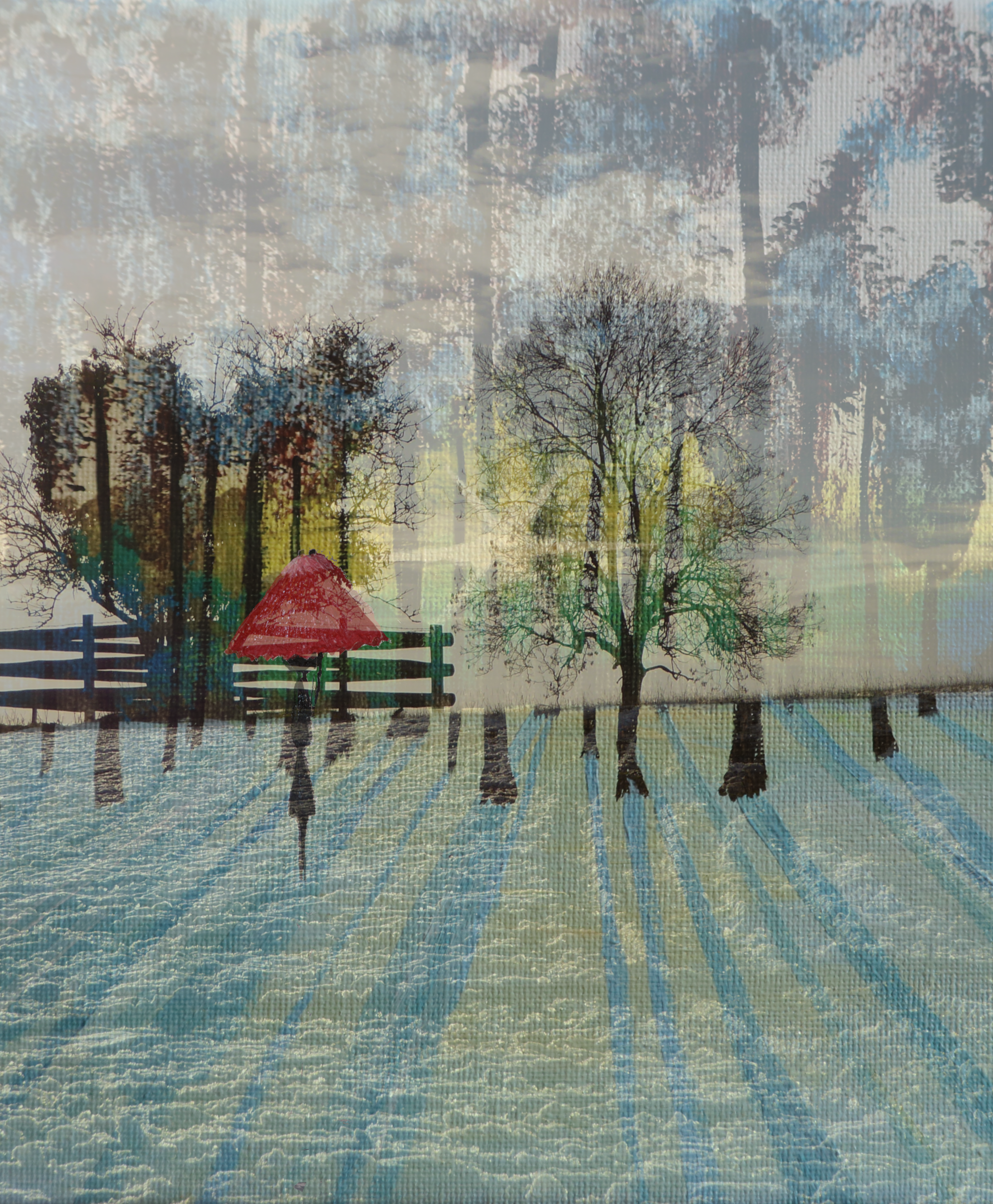
‘forest of silhouettes’ – this work was originally published in Mslexia magazine, http://www.mslexia.co.uk, issue 95, Sept 2022, with the following accompanying poem:

On nearing fifty

Of course, the woman in red is not me,
mist-sunk, shadow-edged, just another tree
in a forest of silhouettes, disappearing…
snowfall all around. Not red, not me.


‘Always in Flight’ (acrylic and photography mixed media) in Bealtaine magazine, issue 2 in spring 2022

OTHER NEWS

My poetry has had more of a political slant than usual lately – a reflection perhaps of the wider world and society around me, similar to what I mention in my new The (arts) view from here section. I am delighted to have 2 of these poems taken for the March issue of London Grip.

Warm seasonal wishes and continued thanks to all my readers, friends and supporters!

Blood Sugar, Sex, Magic

I’m really delighted to be able to share that Blood Sugar, Sex, Magic (Verve Poetry Press) is one of 5 finalists in this year’s international Eyelands book awards published poetry category!!! Big thanks to the award organisers, to the poetry judge, Alicia Hokanson, and to Verve!

Ordering and more information about Blood Sugar, Sex, Magic (Verve Poetry Press, 2022) can be found here or on Verve’s website here.


Ten Lines or More Than Just Love Notes

Big thanks to readers and reviewers for their generous response to my chapbook over the past few months.

“[…] just as James transmutes 10 lines into myriad intriguing forms, the subjects of each piece are expanded from the domestic and mundane – breakfast, beetles, magpies, a wall – into something more far-reaching, philosophical, and eternal. […] anyone can pick up this book, flick to a page, and immerse into a reality that’s familiar, at first, before expanding almost immediately into something more – from micro, to macro, to cosmic. And, within the restraint of just 10 lines, that’s a marvel, marvellously done.”
Mab Jones, Buzz Magazine, full review here.

“[…] Sarah James (probably wisely) keeps to free verse, but she does vary the poems skilfully by changing stanza breaks and by including a concrete poem, a specular poem, a found poem and a visual pun.
“Many poems are about a relationship breakdown; others concern parenting, illness, and aging. The themes sound heavy but are held with lightness and a sense of hopefulness: light itself is a recurring motif.
“The best poems combine a meditative quality with a strong central image; and the brevity of the ten-line format helps keep us focused […]”
Annie Fisher, OPOI, full review here.

More about Ten Lines or More Than Just Love Notes and a book bundle for this title with my full collection Blood Sugar, Sex, Magic (Verve Poetry Press, 2022), for just £12 with UK delivery here.

OTHER POETRY NEWS

I mentioned in my last blogpost about my short eco-inspired pamphlet RAIN FALLING winning the Wigtown Poetry Prize Alastair Reid Pamphlet Prize 2022. Unfortunately, the pamphlet wasn’t ready in time for the awards evening at this year’s festival. But the judges’ reports for all the Wigtown prizes can now be found here.

Big thanks to all involved in making this prize happen, and to the pamphlet competition judge, Vahni Capildeo, who said: “[…]deliberately delicate and pretty language charts flux and destruction. This is the individual lyric’s ability to sing, lovingly attuned to our common home, turning into collective lament. The techniques match the preoccupations: pleasing, quietly alarming repetitions and re-cyclings in forms that have been crafted as fixed, while the voice continues flowing as if free.”

And, hopefully, I’ll also have news on the publication date soon!

My other big news is winning second prize in the Leeds Peace Poetry Competition 2022 with my poem ‘counting the cost’. The contest theme was global health justice, so it’s probably no surprise to anyone who knows me that I chose to focus on the impact of diabetes, the cost of treatment and the problems this can cause for those without health insurance or access to the best treatments.

I was delighted to be invited to write a poem, With Open Eyes For Durga Puja, for United Hindu Cultural Association London’s magazine celebrating Durga Puja 2022.

My poem ‘How the woods dream’ was published in Black Bough Poetry’s The Dai Fry Prize for Mystical Poetry 2022 anthology Sun-Tipped Pillars of Our Hearts in autumn 2022.

Another poem, ‘Limited Hiding’, has been published in the TORCH (The Oxford Research Centre in the Humanities) online anthology A tapestry of home (page 65).

I’m also delighted to have a photo and poem accepted for the next issue of US (and digital) magazine Beachcombing, volume 34, January/February, mailed out in December.

One of my eco poems has been accepted for the Morning Star, and a light-hearted poem for Spilling Cocoa over Martin Amis. More on both soon!

A RECOMMENDATION

‘Evocative, precise and moving, Lesley Quayle’s collection is full of movement, sound and life – of places, people, animals, nature, myth… These are poems resonant with both “the knowledge of frost” (‘Fell Rescue’), and lines, imagery and metaphors as “exquisite as frost” (‘October’). Even those rooted in experiences that are “nightcapped with pain” (‘October’) invite us to “fill up the hollow heart” (‘Fall’). I come away with a re-awakened sense of wonder, and keen to re-read for more “runes of wind over water” (‘City Wakes’), the delight of feeling “knee-deep in sunlight” (‘Isaac among the buttercups’), and drawn back too by haunting characters like ‘The Invisible Woman’.’
Sarah Leavesley

Endorsement for Lesley Quayle’s The Invisible Woman (Yaffle Press, 2022)

Powered by WordPress Web Design by SRS Solutions © 2026 Sarah James Design by SRS Solutions